
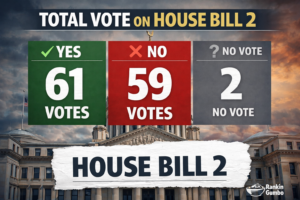
On Thursday, January 15, 2026, the Mississippi House of Representatives gave House Bill 2 (HB 2) — a shockingly narrow 61–59 victory after hours of debate. Two Republicans didn’t vote at all. That’s not a landslide — that’s a stumble over the finish line.
Now, what passed the House isn’t just a school choice bill. It’s a legislative jigsaw puzzle wrapped in 500+ pages, featuring a mix of highly contentious proposals, some quietly divisive policy changes, and a lot of political theatre. And that’s before it hits the Mississippi Senate, whose leadership has been blunt: the Senate isn’t likely to approve the sweeping voucher parts of this bill.
What HB 2 Really Is — and Isn’t
Let’s get one thing straight: HB 2 is not just about school choice — it’s an omnibus education bill that tucks multiple major reforms into one ginormous package. Think of it like the legislative version of a mystery grab bag — and people hate mystery grab bags. Here’s what’s in it:
🔹 School Vouchers / Education Savings Accounts (“Magnolia Student Accounts”)
The headline — and the biggest political flashpoint — is what supporters call an Education Savings Account (ESA) program, otherwise known in everyday language as vouchers. Under this proposal, Mississippi would create Magnolia Student Accounts, allowing families to use public money toward private school tuition and other qualifying education costs.
Critics argue this is basically public money going to private schools that don’t have to play by the same rules as public schools — no state testing, no accountability to the public system — yet still siphoning funds away from the very system that educates the majority of students.
Supporters counter that it gives parents choice and pressure-tests public schools by allowing families to seek alternatives if local schools aren’t meeting specific needs.
🔹 Public-to-Public Transfers
HB 2 would also make it easier for students to attend public schools in districts other than their home district. Schools would have to publish capacity information and transfer criteria — and funding would follow students in some circumstances.
This might sound reasonable — unless you live in a district next door and suddenly find out your neighbors have opened up seats that affect your tax base or classroom sizes.
🔹 Charter School Expansion
Charter school authority would grow under this bill, further diversifying the types of public education options available — and dialing up the debate about accountability, funding, and equity.
🔹 Other Provisions You May Have Heard About
You’ve likely seen people talk about a teacher raise being “in” this bill. Let’s be clear:
- HB 2 does include an assistant teacher pay raise and some financial literacy and staffing flexibility measures.
- HB 2 does not contain a broad, across-the-board raise for certified teachers the way the Senate has been pushing separately.
So if someone tells you legislators slipped a “teacher raise” into this novel to get votes — that’s only true if you stretch the definition to include assistant teachers and not full teacher pay increases. It’s a classic political reframe, and it’s causing plenty of eye-rolls.
The Vote: Who Said Yes, Who Said No — and Which R was Missing in Action
When the final tally came in Thursday, it was 61 votes for, 59 against, and 2 members not voting. That’s razor-thin in a chamber with a Republican majority.
Some Republicans broke with party leadership — 17 of them, in fact — and voted no. Two others simply weren’t present to cast a vote.
That tells you something: this isn’t your typical partisan roll call. This was a fractured alignment where some Republicans and basically all Democrats stood against something framed as a flagship Republican policy.
Rankin County’s Delegation: Split Decisions and a No-Show
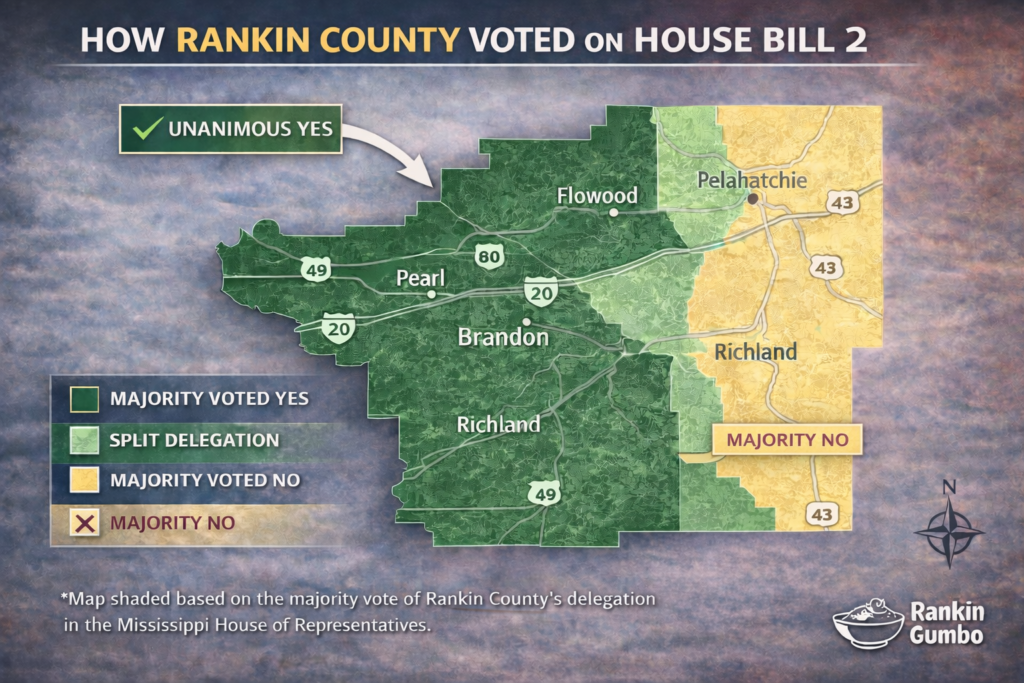
Here’s where it gets interesting for our home crowd in Rankin County. Our delegation was not together on this one. And because the margin was so tight, every vote here mattered.
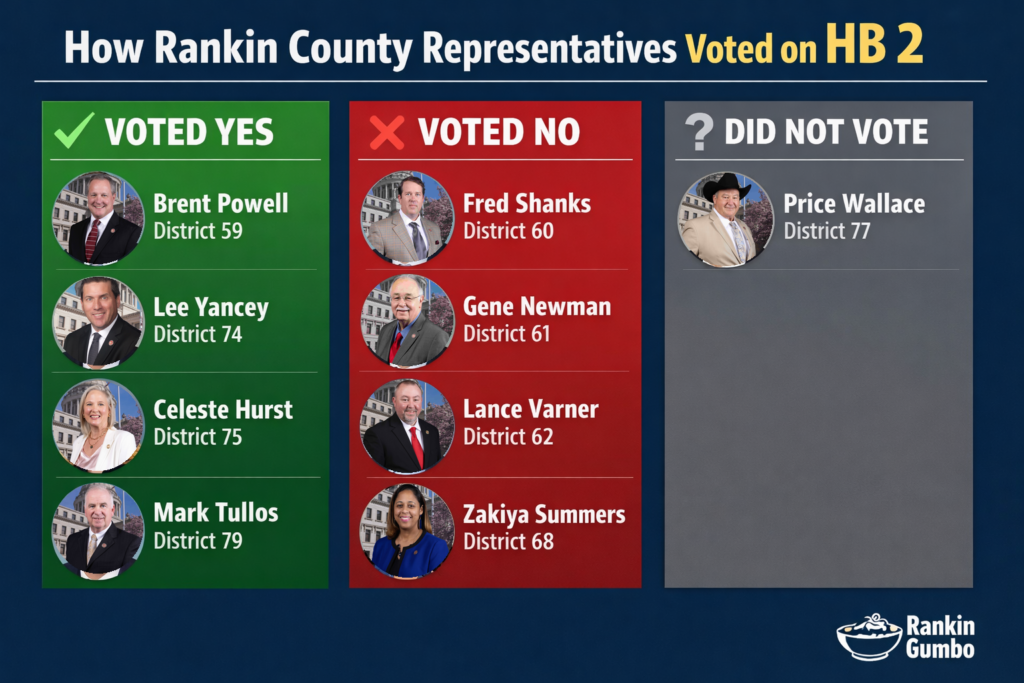
Rankin County lawmakers who voted YES on HB 2:
- Brent Powell (District 59) — YES
- Lee Yancey (District 74) — YES
- Celeste Hurst (District 75) — YES
- Mark Tullos (District 79) — YES
Rankin County lawmakers who voted NO:
- Fred Shanks (District 60) — NO
- Gene Newman (District 61) — NO
- Lance Varner (District 62) — NO
- Zakiya Summers (District 68) — NO
Absent / Didn’t Vote:
- Price Wallace (District 77) — Not voting/absent
So on the bill that may reshape the state’s education landscape, Rankin County’s delegation split right down the middle.
What’s Next: The Senate and the Likelihood of a Rewrite or Rejection
Once the House passed the bill, it went straight to the Mississippi Senate — where leadership has been explicit that broad voucher programs are probably a nonstarter.
So now we enter what political insiders call “conference season” — where House and Senate versions of legislation are negotiated. If the Senate refuses the controversial elements (like Education Savings Accounts), the bill could either:
- Be heavily rewritten to strip those pieces,
- Die quietly in committee, or
- Force a last-minute compromise that pleases no one.
That uncertainty is exactly why this bill — passed by two votes — is already being talked about as the defining education battle of the 2026 session.
Why This Controversy Isn’t Going Away Anytime Soon
What’s interesting here isn’t just the policy — it’s how politics are playing out.
- A bill marketed as school choice becomes controversial because it ties together so many elements that neither side fully loves.
- Republicans can’t unanimously support something their own leadership pushed.
- Democrats can use that fact to argue the bill isn’t about educating kids as much as it’s about ideology.
And because this debate pits public school infrastructure against private schooling with public dollars, every conversation about it is going to bring out strong reactions.
How Mississippi House Delegations Voted on HB 2 (By County Majority):
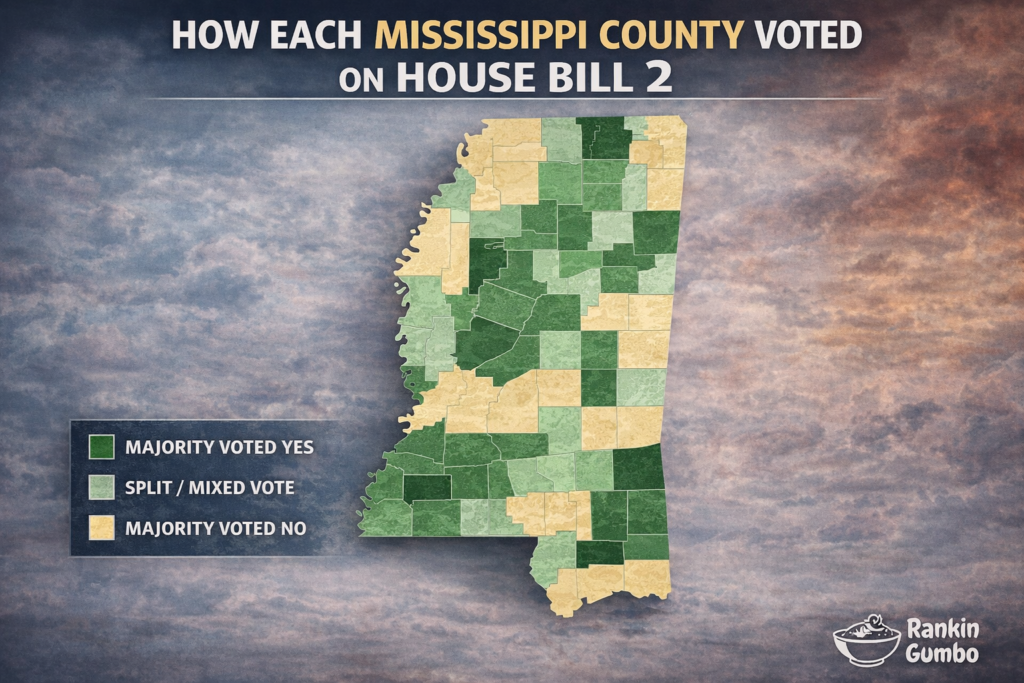
Note regarding state graphic, above: Color based on the majority vote of House members representing each county. Some counties are represented by multiple districts.
Full House roll call: who voted YES, who voted NO, who didn’t vote
Below is the official list from the House vote record.
YES (61)
Aguirre; Anderson (122nd); Arnold; Bailey (23rd); Barnett; Barton; Bell (21st); Blackwell; Bounds; Boyd (19th); Burch; Byrd; Carpenter; Cockerham; Creekmore IV; Estrada; Eubanks; Eure; Felsher; Fondren; Ford (54th); Grady; Guice; Hale; Hall; Harris; Hawkins; Hood; Horan; Horne; Hurst; Keen; Kinkade; Lamar; Lott; Mangold; Massengill; Mattox; McKnight; McMillan; Mims; Morgan; Oliver; Owen; Pigott; Powell; Read; Remak; Roberson; Rushing; Sanford; Scoggin; Steverson; Tubb; Tullos; Turner; Waldo; Yancey; Yates; Zuber; Mr. Speaker.
NO (59)
Anderson (110th); Anthony; Bailey (49th); Banks; Bell (65th); Bennett; Blackmon; Boyd (37th); Brown; Burnett; Butler-Washington; Calvert; Clark; Crawford; Crosby; Crudup; Currie; Denton; Elliott; Evans; Faulkner; Ford (73rd); Foster; Gibbs (36th); Gibbs (72nd); Haney; Harness; Hines; Hobgood-Wilkes; Holloway (27th); Holloway (76th); Hulum; Jackson (11th); Jackson (45th); James-Jones; Johnson; Karriem; Ladner; Mansell; McCarty; McCray; McGee; McLean; Mickens; Nelson; Newman; Osborne; Porter; Rosebud; Sanders; Scott; Shanks; Smith; Summers; Taylor; Thompson; Varner; Watson; Williams.
Absent / Not voting (2)
Deweese; Wallace.
If you’d like to make a comment on a post, just create your login and make your comment.